

Do You Need Duct Cleaning After Construction? What Austin’s Building Boom Leaves in Your Vents
The short answer: Yes, if the project involved drywall sanding, demolition, tile cutting, or floor refinishing. And yes for most brand-new Austin homes, because builder contracts almost never require a real duct cleaning before closing. Schedule it 1-2 weeks after the final sanding, never before, and run the white-cloth test below to check for yourself.
Austin has spent a decade as one of the fastest-growing metros in the country. That growth has a hidden air quality cost: thousands of duct systems that started their working life full of construction dust. Our Supreme Air Care crews open new-build systems in Leander, Kyle, and Georgetown every month, and what we find inside rarely matches the spotless house the buyer walked through.
Why is construction dust different from regular house dust?
Regular household dust is mostly lint, skin cells, pet dander, and outdoor particles. Construction dust is a different material with different behavior:
- Drywall dust (gypsum) is fine and abrasive. It slips past builder-grade filters and grinds at whatever it lands on.
- It insulates motors. A coating of drywall dust traps heat inside the blower motor. One factory technical bulletin found that 40% of failed blower motors returned under warranty had failed because of drywall and construction dust, usually because the system ran during construction without proper filtration. That is not an air quality statistic. That is a dead motor statistic.
- It carries crystalline silica from concrete and tile work, which is not something anyone should breathe for months while it slowly clears the system.
- It is heavy and settles deep. Fine gypsum packs into duct runs and register boots and re-launches every time the system starts, which is why fresh-remodel homes feel dusty again a day after cleaning the floors.
Do new-build homes really need duct cleaning?
More often than not, yes, and here is the uncomfortable reason: nobody was responsible for making the ducts clean.
The EPA’s own guidance on duct protection during construction notes that dust and debris enter ductwork even when the system is not running: open register boots collect sawdust, drywall scraps, carpet fibers, and construction trash during the build. It also points out that flex duct, with its grooved interior surface, is especially prone to harboring construction dust. Nearly every new home in the Austin suburbs runs flex duct.
Meanwhile, the typical builder contract requires a broom-clean house, not a NADCA-standard duct cleaning. The crews sweep what you can see. What sits inside the supply runs is the buyer’s problem after closing.
Our crews see the result constantly: a six-month-old home in Kyle where the register boots hold a visible layer of white powder, or a Georgetown new build where the “dusty smell” every time the AC starts turns out to be gypsum baked onto the blower.
When should you schedule the cleaning?
Timing matters more than most homeowners expect. Use this table:
| Situation | What to do |
|---|---|
| Major remodel (drywall, demo, flooring) | Clean 1-2 weeks after ALL dusty work ends |
| HVAC ran during the construction | Cleaning strongly recommended; the system inhaled dust the entire time |
| System was off and vents were sealed | Inspect first; you may only need a lighter cleaning |
| Brand-new home | Clean before move-in, or run the white-cloth test at your walk-through |
| Paint-only project, no sanding | Usually just a filter change; inspect if in doubt |
The one rule that never changes: never clean before the dusty work is finished. A cleaning during the project gets re-contaminated by the next round of sanding, and you pay twice. Waiting a week or two after the final punch-list work lets airborne dust settle so one cleaning removes all of it.
The white-cloth test: check your own ducts in two minutes
You do not need our word for any of this. At your walk-through or any time after a remodel:
- Take a clean white cloth or a white sock
- Pull a supply register off the wall or floor (they lift out or unscrew in seconds)
- Wipe the inside of the duct boot as far as you can comfortably reach
- Look at the cloth
Fine white chalky residue means drywall dust is in the system. Sawdust or grit means the boots caught construction debris. A cloth that comes back mostly clean means you may only need a fresh filter, and we will happily tell you exactly that if we inspect and find the same thing.
For buyers still before closing: run this test during the final walk-through and ask the builder directly who cleaned the ducts and how. The answer is usually a blank look, and that answer is leverage.
What does a proper post-construction cleaning involve?
Fine gypsum is the exact material that separates real equipment from shop-vac operations. Dust this fine goes airborne at the first touch of a brush. Without the whole system under strong negative pressure, agitation just relocates it from the ducts into your living room air.
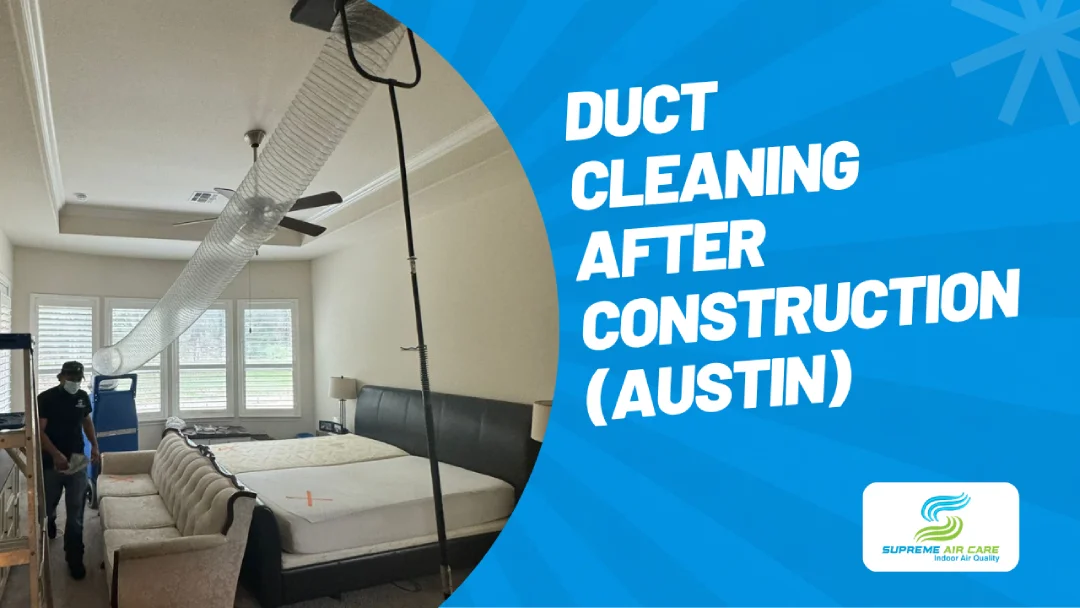
A proper post-construction cleaning at Supreme Air Care means the full system under truck-mounted negative pressure, mechanical agitation down every supply and return run, register boots cleaned by hand, a filter change at the end, and before/after footage so you can see the difference instead of trusting an invoice. It is the same inspection-first process our reviewers describe on regular jobs, applied to the heaviest debris load a residential system ever carries.
Pricing sits at the higher end of duct cleaning because the debris load is heavier and the work is slower. Real Austin ranges are in our air duct cleaning cost guide, including what heavy-buildup jobs typically run. For what a standard cleaning includes on a lived-in home, see our residential duct cleaning page.
Post-construction duct cleaning FAQs
Is duct cleaning necessary after a renovation?
If the work involved drywall sanding, demolition, or tile cutting, almost certainly yes. Gypsum dust bypasses standard filters, abrades and overheats HVAC components, and recirculates for months. Paint-only projects usually just need a filter change.
Should I clean the ducts before or after construction?
After. Always. Cleaning before or during the project wastes the money because the following work re-contaminates the system. Schedule for 1-2 weeks after the final sanding.
Do brand-new houses need duct cleaning?
Frequently, yes. Debris enters open ductwork throughout the build even when the system never runs, flex duct interiors trap it, and builder contracts rarely require a real duct cleaning before closing. Run the white-cloth test at your walk-through.
Can construction dust damage my HVAC system?
Yes. Drywall dust insulates blower motors and causes overheating; one manufacturer bulletin attributed 40% of returned failed blower motors to construction dust. It also clogs coils and shortens filter life.
How soon after moving in should I test for it?
Immediately. The white-cloth test takes two minutes. If the home is new to you and the ducts’ history is unknown, an inspection with camera footage settles the question either way.
Supreme Air Care is a family-owned air duct and dryer vent cleaning company serving Austin, Round Rock, Cedar Park, Pflugerville, and surrounding Central Texas communities for 15+ years, with more than 60,000 duct and vent cleanings completed. Every job starts with an inspection and ends with photo and video proof of the work.