


Cedar Fever Survival Guide for Austin Homes: What Actually Works, Month by Month
The short answer: Cedar fever season runs roughly December through February in Austin, peaking in January. The three highest-impact moves for your home: upgrade to a MERV 11–13 filter before December, keep the house sealed on dry windy mornings, and schedule duct cleaning after the season ends, not before, so you remove the accumulated pollen instead of paying twice.
Every winter, Ashe juniper trees (what Texans call mountain cedar) west of Austin release pollen in visible orange clouds. Peak-week counts are severe enough that Austin allergists treat cedar as its own season. The symptoms include congestion, fatigue, itchy eyes, and even a low-grade “fever” feeling, and they hit people who have never had allergies anywhere else.
We can’t fix the trees. But our Supreme Air Care crews have spent 15+ years inside Central Texas duct systems, with more than 60,000 duct and vent cleanings completed, so we know exactly how cedar pollen behaves once it gets into an Austin home. Most of the advice online gets two important things wrong. Let’s fix that.
How does cedar pollen get inside your house?
Four routes, in order of volume:
- Open doors and windows. Cedar pollen grains are 20–40 microns: big enough to see as dust, light enough to ride any breeze. Peak release is dry, windy mornings, roughly 5–10 a.m.
- Gaps in the building envelope. Weatherstripping and door sweeps are the cheapest defense you can buy.
- Leaky ductwork in the attic. This is the one Austin homeowners miss. Most local homes run flex duct through an unconditioned attic. If the return side leaks, your system pulls unfiltered attic air, loaded with whatever blew in through the soffit vents, straight into your supply air.
- Hitchhiking. On your hair, clothes, and pets. A shower and a change of clothes after outdoor time during peak season genuinely helps.
Once inside, your HVAC system becomes the distribution network. While the blower runs, a typical residential system cycles your home’s entire air volume roughly every 15–20 minutes, so pollen that settles into ductwork gets re-launched into every room each time the system starts.
What’s the best HVAC filter for cedar season?
MERV 11 to MERV 13, changed every 30–45 days during the season. This is the single highest-value upgrade, and it costs about $25.
- Standard 1-inch fiberglass filters (MERV 1–4) are designed to protect the equipment, not your lungs. Most pollen sails through.
- MERV 11 captures the majority of pollen-sized particles. MERV 13 captures 85–90% of even the fine 1–3 micron range. Cedar pollen, at 20–40 microns, is far larger than that, so both filters catch it at even higher rates. The 1–3 micron figure matters for the finer dust and spores that ride along with it. ASHRAE recommends MERV 13 as the residential minimum where air quality is a priority.
- Don’t go above MERV 13 without checking your system. Very high MERV filters restrict airflow and can strain the blower. Most systems built after 2010 handle MERV 13. If you’re unsure, Supreme Air Care technicians check static pressure as part of every HVAC cleaning evaluation, so you get a real answer instead of a guess.
One filter mistake we see constantly in January: a MERV 13 filter that hasn’t been changed since October. During cedar season a loaded filter chokes airflow, and some of the air simply bypasses it through gaps. A cheap filter changed monthly beats an expensive filter changed never.
Fan ON or AUTO during cedar season?
You’ll find confident advice in both directions online. Here’s the actual logic so you can decide:
- Fan ON runs air through your filter continuously, even when the system isn’t heating or cooling. If you have a good MERV 11–13 filter, this means more filtration passes per day, which is useful during the 5–10 a.m. pollen peak.
- Fan AUTO filters only while heating or cooling. If your filter is builder-grade or overdue for a change, AUTO at least avoids constantly re-stirring settled dust through a filter that isn’t catching much.
Our recommendation at Supreme Air Care: with a fresh MERV 11–13 filter installed, run the fan ON during the 5–10 a.m. morning pollen peak in December through February, and AUTO the rest of the time. Without a good filter, the fan setting won’t save you. Fix the filter first.
Should you clean your air ducts before or after cedar season?
Here’s where Supreme Air Care disagrees with companies that would happily book you twice: after the season, in March or April, not before.
The reasoning is simple. A cleaning in November removes whatever’s in the ducts. Then December through February reloads them with three months of cedar pollen. Come spring, you’re living with a fresh reservoir that recirculates every time the AC starts, which is why plenty of Austinites are still sneezing indoors in April when the outdoor counts have already dropped.
A post-season cleaning removes the entire winter’s accumulation once, right before Austin’s long AC season seals you in with it.
Two honest caveats, because a cleaning isn’t always the answer:
- The EPA’s position is that duct cleaning is clearly warranted when there’s visible mold, pest activity, or substantial debris, not as a reflexive annual ritual. We agree. If your ducts were professionally cleaned within the last 3–5 years and this cedar season was mild for you, a filter upgrade may be all you need this year.
- If you’ve never had your ducts cleaned, or you just moved into a new build (Austin’s new-construction flex duct routinely ships full of drywall dust), the “wait until April” rule matters less. Book an inspection whenever, and we’ll show you camera footage of what’s actually in there before you decide. Wondering about price? See our Austin air duct cleaning cost guide.
This is the same inspection-first rule we apply to every service: we look first, show you what we found, and tell you honestly if you don’t need us this year. It’s why our reviews mention fair pricing more often than any discount.
What we find in Austin ducts every April
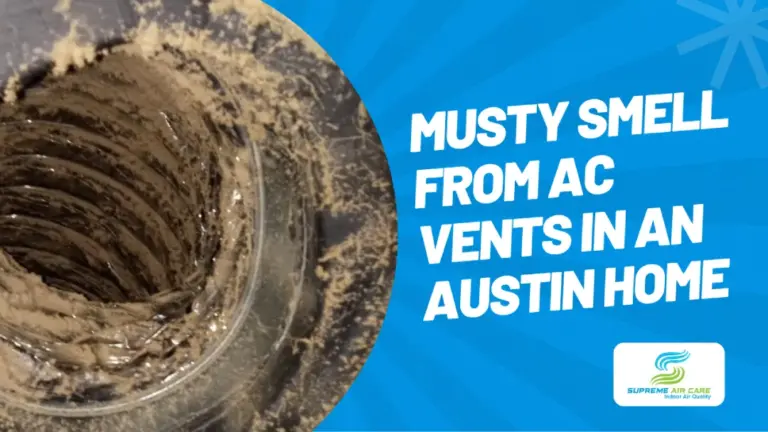
Each spring our Supreme Air Care crews (Eli, Alex, Chris, Stacy) open up systems across Austin, Round Rock, and Cedar Park, and the pattern is the same: a fine yellow-tan dust coating the supply runs, heaviest near the returns, mixed with regular household dust into a felt-like layer. Homeowners are usually surprised when we show them the before video. The pollen cloud outside in January was visible, but nobody thinks about where it settles.
One of our customers, Elias, booked a flex duct cleaning and mentioned in his review that Stacy and Chris “even showed me how the process works.” That walkthrough is standard on every Supreme Air Care job. Seeing your own before footage is what makes the yellow film real, and it’s how you know the cleaning you paid for actually happened.
Equipment matters here too, and it’s a real difference between companies. Plenty of outfits in Austin still clean with portable shop-vac rigs. Supreme Air Care runs the Hypervac H2, a truck-mounted negative air system, because agitating that pollen layer without serious suction doesn’t remove it. It blasts it into your living space. Negative pressure is the difference between removing the reservoir and redistributing it, and it’s worth asking about no matter which company you hire.
Do UV lights help with cedar fever?
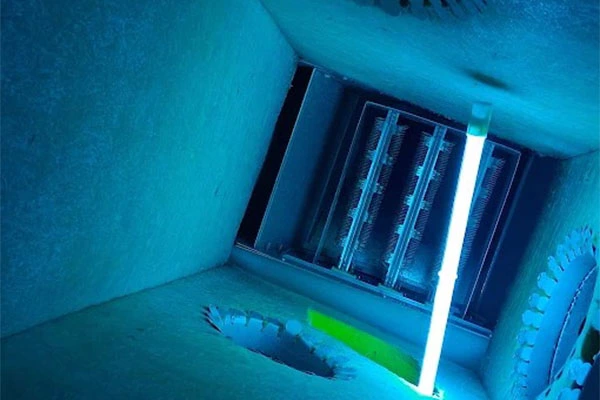
Honest answer: not directly. And yes, we say that as a company that installs UV lights. UV-C light neutralizes biological growth (mold and bacteria on your evaporator coil). It doesn’t remove pollen, which is inert plant material that needs to be filtered or physically removed.
Where UV does fit the cedar picture: Austin’s humid climate plus a dark, damp coil is ideal for microbial growth, and allergy-prone households react to that mold load on top of the pollen load. Filter for the pollen, UV for the biology. Two different problems, two different tools. Anyone selling UV as a pollen fix is selling the wrong tool.
Your month-by-month cedar plan
| When | What to do |
|---|---|
| October – November | Install a fresh MERV 11–13 filter. Weatherstrip doors and windows. If your ducts run through the attic, have leaks checked and sealed. |
| December – February | Windows closed, especially dry windy mornings (5–10 a.m. peak). Fan ON during morning hours with a fresh filter. Change the filter every 30–45 days. Shower/change after outdoor time; wipe down pets. |
| March – April | Book the post-season duct cleaning to remove the winter reservoir. Swap in a fresh filter after the cleaning. This is also when spring oak pollen starts; Austin rarely gives you a break. |
| May – September | Normal filter schedule (every 60–90 days). Keep indoor humidity in the 30–50% range so summer doesn’t trade your pollen problem for a mold one. |
Cedar Fever FAQs for Austin Homes
When is cedar fever season in Austin?
Roughly December through February, occasionally stretching into early March. Pollen release peaks in January, on dry, windy mornings after cold fronts.
Does air duct cleaning help with cedar fever?
It helps if your ducts actually hold accumulated pollen, which in Austin, after a full season, they usually do. The biggest benefit comes from a post-season cleaning (March–April) paired with a MERV 11–13 filter. It is not a substitute for filtration during the season.
What MERV rating should I use for cedar pollen?
MERV 11–13. Cedar pollen grains are 20–40 microns, well within reach of these filters. Go to MERV 13 if your system supports it, and don’t go higher without an airflow check.
Should I run my HVAC fan ON or AUTO during cedar season?
With a fresh MERV 11–13 filter: ON during morning peak pollen hours, AUTO otherwise. With an old or builder-grade filter, the setting hardly matters. Change the filter first.
Why am I still sneezing indoors in April after cedar season ends?
Because your ductwork spent three months collecting pollen and re-releases some of it every time the system runs. That trapped reservoir is exactly what a post-season duct cleaning removes.
Supreme Air Care is a family-owned air duct and dryer vent cleaning company serving Austin, Round Rock, Cedar Park, Pflugerville, and surrounding Central Texas communities for 15+ years, with more than 60,000 duct and vent cleanings completed. Every job starts with an inspection and ends with video proof of the work.