

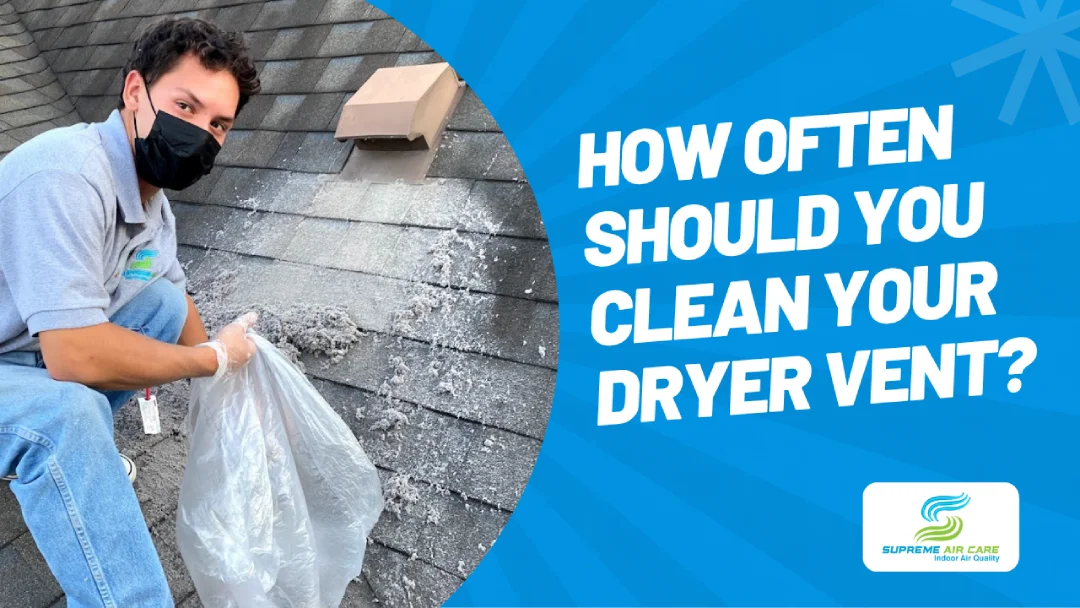

The short answer: Clean your dryer vent once a year for most households, and every six months if your vent run is longer than 25 feet, shared with another unit, or you dry four or more loads a week. If your clothes already take two cycles to dry, you are past due, not on schedule.
That answer comes from more than convention. The U.S. Fire Administration reports around 13,800 clothes dryer fires per year in American homes, and failure to clean the vent is the leading factor, involved in roughly 30% of them. Lint is one of the most flammable materials in your house, and your dryer pushes hot air through a tube packed with it every single day.
Our Supreme Air Care crews have been cleaning dryer vents across Austin for 15+ years, and we have seen both ends of this story: the routine annual cleanings that take an hour, and the aftermath calls that involve a fire report. This guide covers the schedule, the warning signs, and the Austin-specific problem that most national advice never mentions.
How often should you clean your dryer vent?
Use this schedule as your baseline:
| Situation | Cleaning frequency |
|---|---|
| Typical household, short vent run | Once a year |
| Vent run over 25 feet, or with multiple bends | Every 6 months |
| Four or more loads per week (big families, pet bedding) | Every 6 months |
| Shared or stacked units (duplexes, apartments) | Every 6 months |
| Gas dryer | Annual professional service at minimum, for CO safety as well as lint |
| You just bought the house | Now. You have no idea when it was last done. |
Appliance manufacturers put it plainly in their own venting specifications: every exhaust system must be inspected periodically and cleaned, and complaints of long drying times or a hot dryer top indicate the need for inspection. In other words, the industry that builds the dryers assumes you are doing this.
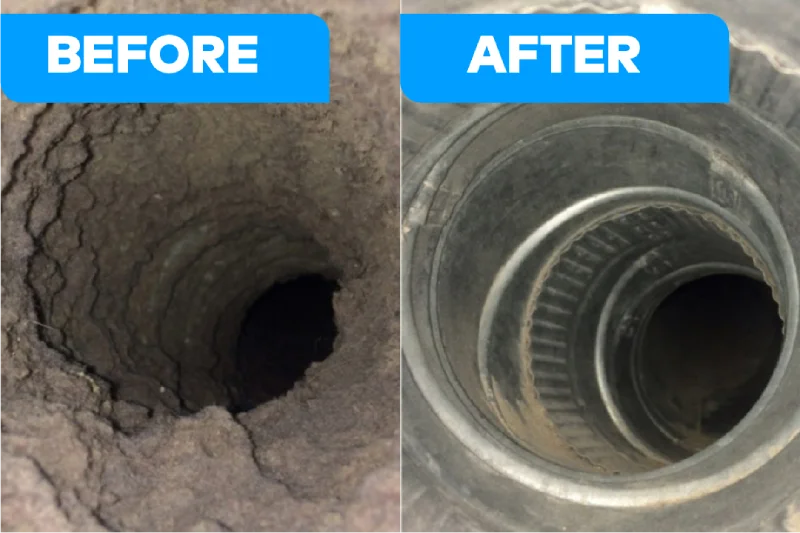
What are the signs your dryer vent is clogged?
Here is the part most articles get wrong: they present warning signs as if noticing them means you are catching the problem early. You are not. These signs mean the blockage is already serious:
- Clothes take longer than one cycle to dry
- The top of the dryer feels hot to the touch
- A burning smell during operation
- The laundry room feels humid or warmer than usual while the dryer runs
- Lint collecting around the outside vent flap, or the flap barely opens
- The lint trap fills with fine lint after a single load
Any burning smell deserves zero risk tolerance. Turn the dryer off and get the vent inspected before running it again. One of our customers, James, called us after a garage fire filled his house with smoke. Our crew cleaned the ductwork to stop the smoke from recirculating, and while we were there, our inspection found his dryer vent severely restricted. In his own words in his review, a second fire was “the last thing I need.” That restriction had been building silently the whole time.
We also regularly handle insurance-assigned cleanings after small fires, like the job our reviewer Jeremy described. By that point the cleaning is part of a restoration claim. An annual cleaning costs a fraction of that deductible.
Why do Austin homes hit the 25-foot problem?
National guides rarely mention this, but it is the single biggest factor we see in Austin’s newer neighborhoods.
Building codes and UL standards limit a dryer vent to a maximum of 25 feet, and every bend shortens that allowance: a 90-degree elbow subtracts 5 feet, a 45-degree elbow subtracts 2.5 feet. Now think about the two-story homes going up across Round Rock, Pflugerville, Leander, and Kyle. The laundry room is often in the middle of the house, upstairs, and the vent run travels through walls and the attic before terminating at the roof.
Two problems follow from that:
- Long runs with multiple bends collect lint faster and are impossible to clean with a brush kit from the hardware store. The lint packs into the elbows where short tools never reach.
- Roof-terminating vents fail invisibly. You cannot walk past a roof cap and notice lint the way you can with a wall vent. We find roof caps in Austin subdivisions completely matted over, sometimes with bird nesting on top of the lint. The homeowner had no way to see it.
If your dryer is not on an exterior wall, assume you have a long run and treat the six-month schedule as yours.
Can you clean a dryer vent yourself?
Honestly: sometimes. If your dryer sits on an exterior wall with a short, straight run to a wall vent, a $25 brush kit and a shop vacuum will do a reasonable job once a year. We would rather you do that than do nothing.
Call a professional when any of these apply:
- The vent runs more than a few feet or has elbows you cannot see
- The vent terminates at the roof
- The run passes through the attic
- Drying times stay long after you have cleaned what you can reach
- It is a gas dryer and it has never been professionally serviced
The difference is equipment and verification. A proper cleaning uses a rotary brush that travels the full length of the duct while a vacuum captures what it dislodges, followed by an airflow check to confirm the line is actually clear. At Supreme Air Care every dryer vent cleaning starts with an inspection and ends with proof: our crews photograph and video the process, the same way reviewer Rachel described when Eli’s team shared photos and videos of her vent job. If a company cannot show you what they removed, you are taking their word for it.
What does a professional dryer vent cleaning cost?
In Austin, professional dryer vent cleaning typically runs $89 to $250 depending on the run length, termination point, and how restricted the line is. Roof terminations sit at the higher end because they require ladder work at the cap. For context on how this fits alongside duct cleaning prices, see our Austin air duct cleaning cost guide.
Compare that number to the two outcomes it prevents: a dryer that runs double cycles every load (electricity you pay for twice), and the fire statistics at the top of this page.
Dryer vent cleaning FAQs
How often should a dryer vent be cleaned?
Once a year for most homes. Every six months if the run is over 25 feet, shared between units, or the household dries four or more loads per week.
Why do my clothes take two cycles to dry?
Restricted airflow is the most common cause, and lint buildup in the vent is the most common restriction. The dryer cannot exhaust moist air, so clothes stay damp. It is also the earliest practical warning sign of a clog.
Is a clogged dryer vent really a fire hazard?
Yes. The U.S. Fire Administration counts roughly 13,800 dryer fires per year, with failure to clean as the leading contributing factor. Lint ignites easily, and a blocked vent traps the heat that ignites it.
How long does a professional dryer vent cleaning take?
Usually 45 minutes to an hour and a half. Long attic runs or roof terminations take longer than short wall vents.
Do new Austin homes need dryer vent cleaning?
Sooner than you would think. Two-story new builds in Austin suburbs often have long, bent vent runs that reach the 25-foot code limit, and those runs load up with lint faster than a short straight vent. Treat year one as your first inspection.
Supreme Air Care is a family-owned air duct and dryer vent cleaning company serving Austin, Round Rock, Cedar Park, Pflugerville, and surrounding Central Texas communities for 15+ years, with more than 60,000 duct and vent cleanings completed. Every job starts with an inspection and ends with photo and video proof of the work.